
Validated with the people it was built for.
RGCare5 comes from years of Institute research with people who have experienced reproductive loss.
Why a five-question screener.
1 in 4
Pregnancies in the United States end in miscarriage.
25%
Meet the criteria for major depression three months after a miscarriage
25 - 30%
May experience prolonged, complicated grief after a loss, now classified as prolonged grief disorder in the DSM-5-TR
General grief instruments were built for bereavement after the death of an adult, and perinatal instruments that exist are too long for a clinic visit. Clinicians needed something short enough to use, sensitive enough to matter, and specific enough to guide the next conversation.
Five phases of research.
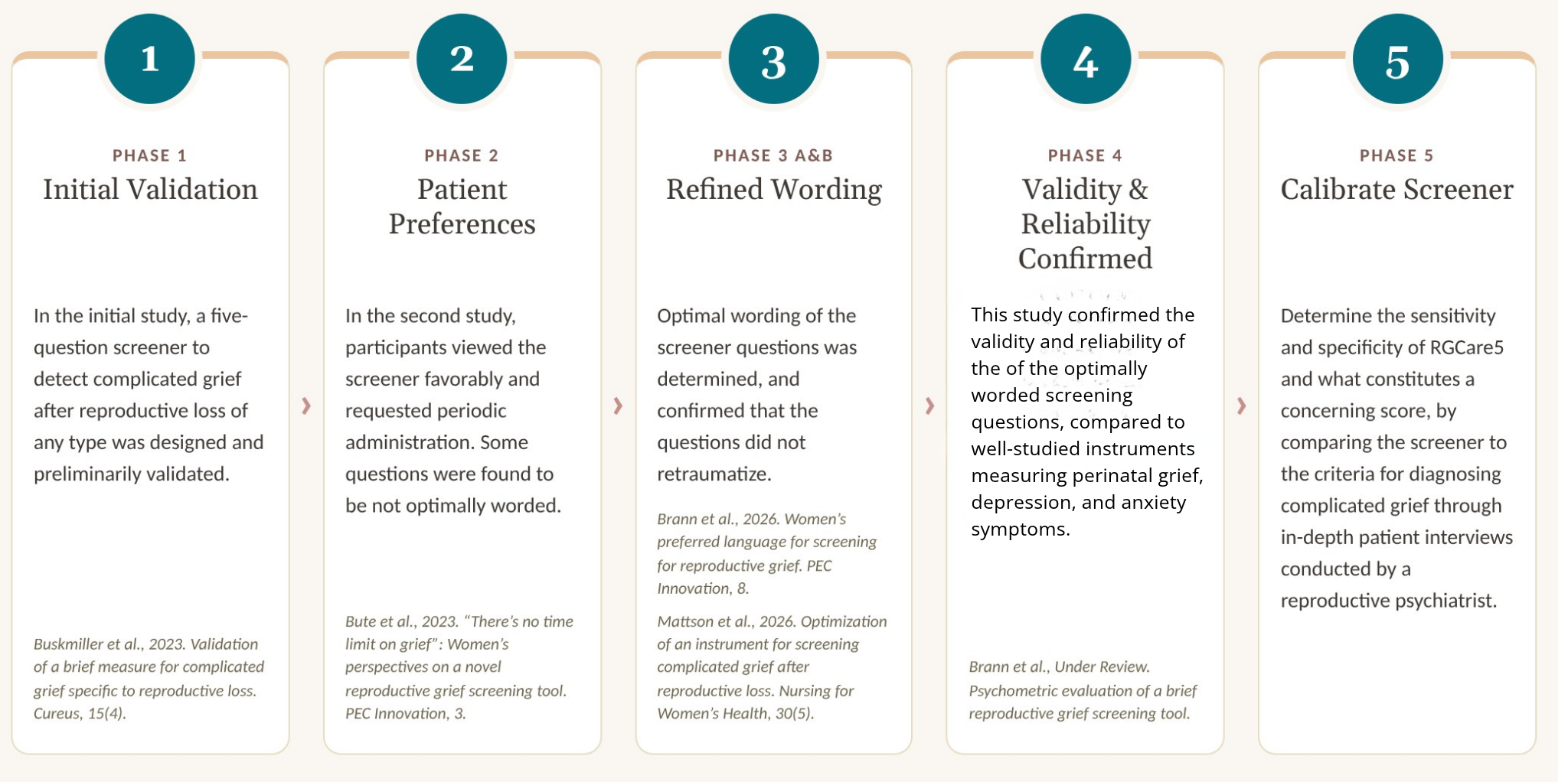
RGCare5 was adapted from the Brief Grief Questionnaire and shaped through Institute studies with more than 1,500 women who had experienced a reproductive loss. They told us they wanted to be screened, that the questions validated their emotions, and that the screener belongs in OB/GYN, primary care and mental health settings. The research also suggests that screening followed by a brief conversation is itself part of care.
Published
Peer-reviewed work on RGCare5.
Buskmiller et al., 2023
Validation of a brief measure for complicated grief specific to reproductive loss. Cureus, 15(4).
Bute et al., 2023
"There’s no time limit on grief:" Women’s perspectives on a novel reproductive grief screening tool. PEC Innovation, 3.
Brann et al., 2026
Women’s preferred language for screening for reproductive grief. PEC Innovation, 8.
Mattson et al., 2026
Optimization of an instrument for screening complicated grief after reproductive loss. Nursing for Women’s Health, 30(5).
Mattson and Berry, 2026
Under review: Brann et al., Psychometric evaluation of a brief reproductive grief screening tool.
The Reproductive Grief Screening Tool Working Group.
The clinicians and researchers who designed, tested and continue to refine RGCare5, working to bridge the gap between healthcare providers, mental health professionals and families, so that no one navigates reproductive grief alone.

Michaelene Fredenburg, LHD hc
President and CEO, The Institute of Reproductive Grief Care

Glorisel González Viera, MD
Reproductive Psychiatrist, Texas Children's Hospital Pavilion for Women

Maria Brann, PhD, MPH
Professor, Communication Studies, Indiana University Indianapolis

Rebecca Mattson, PhD, RN, PHN
Assistant Professor of Nursing, San Diego State University

Jennifer Bute, PhD
Professor, Communication Studies, Indiana University Indianapolis

Sara Dominguez
Strategic Initiatives & Partner Coordinator, Institute of Reproductive Grief Care

Cara Buskmiller, MD, MS
Double board-certified maternal-fetal medicine physician, obstetrician-gynecologist, and assistant professor at Baylor College of Medicine

Jerica Wesley, PhD, LPC, ALPS
Assistant Professor, Marshall University; Licensed Professional Counselor
Work with the Institute.
The Institute welcomes clinical and academic partners for outcomes research and implementation studies.